
By Jack Daneshmand
One of the most important concepts in golf instruction is understanding sequence. A powerful and repeatable swing is not simply about moving fast — it is about moving in the correct order. When the golf swing is sequenced properly, each segment of the body and club builds on the movement before it, allowing speed to develop naturally without sacrificing control. When sequence breaks down, players often compensate with their hands, lose pressure control, and deliver the club inconsistently at impact.
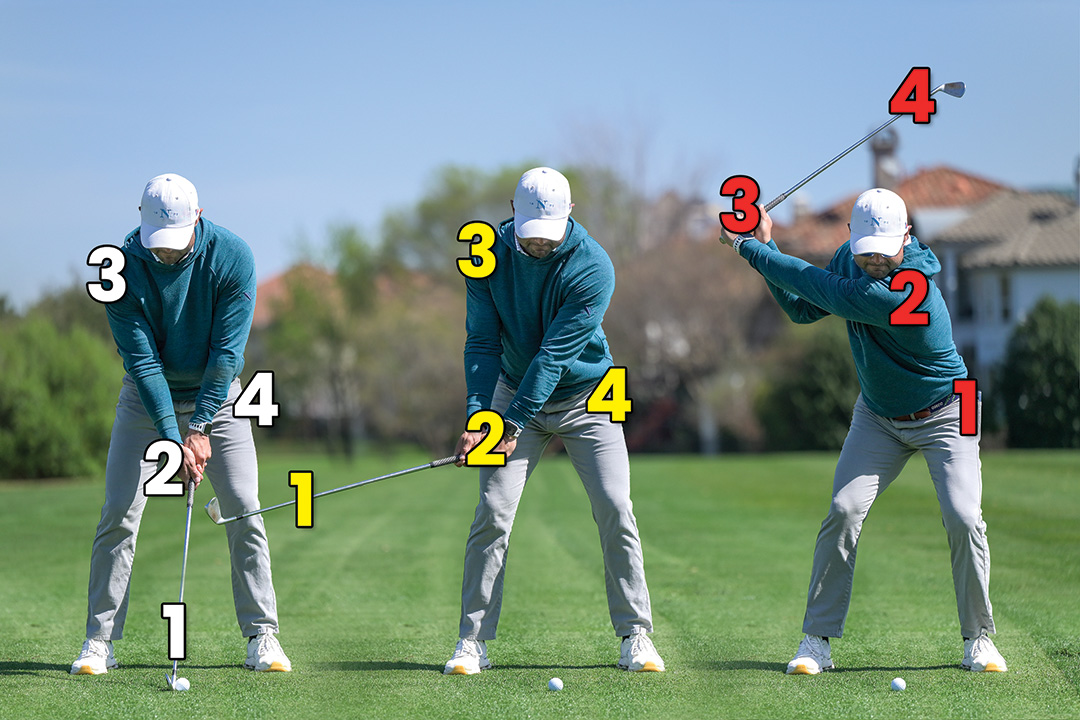
Backswing
1. Club Head • 2. Hands • 3. Torso • 4. Hips
The motion of the swing can be understood through four key pieces: the hips, torso, hands, and clubhead. Each has a role, and each must work in harmony. The golf swing is a chain of motion, and like any chain, it is only as strong as the order in which it functions. In the backswing, the sequence reflects both order and scale of movement. The clubhead travels the greatest distance, moving on a wide arc as the furthest point from the body. The hands support that motion, working upward and around to guide the club without an independent lift. The torso continues the sequence by turning the chest and shoulders to create depth and load while maintaining structure and inclination. At the base, the hips travel the least, providing stability with subtle rotation and pressure shift into the trail side. This relationship — where the clubhead moves the most and the hips the least — creates an efficient and organized backswing structure.
Downswing
1. Hips • 2. Torso • 3. Hands • 4. Club Head
In the downswing, the sequence reverses in order but maintains the same connected chain. The hips initiate the transition by shifting pressure into the lead side and beginning to rotate open. This move creates space and allows the torso to follow, unwinding through the ball while maintaining posture. As the torso rotates, the hands move down and forward, delivering the grip while keeping the clubhead trailing behind. Finally, the clubhead releases through impact with maximum speed. The clubhead arrives last, but it is moving the fastest — this is the hallmark of an efficient swing.
What separates great ball-strikers is not effort, but order. The hips initiate and support, the torso transfers energy, the hands provide structure, and the clubhead releases stored speed. When golfers understand this sequence in both the backswing and downswing, they stop chasing positions and begin developing motion that is athletic, organized, and repeatable. The golf swing is not defined by a single position, but by how the entire system works together from start to finish.
Jack Daneshmand is the Director of Instruction at the Como Coaching Golf Academy at the The Nelson Golf and Sports Club in Las Colinas.